

We have backed Arintra for a third time. TEN13 is joining Arintra's US$25m Series B, led by Define Ventures, with continued participation from Peak XV Partners.
Arintra builds agentic AI that codes the medical charts US health systems depend on to get paid. We first backed founders Nitesh Shroff and Preeti Bhargava at post-seed, returned for the Series A, and are investing again because the company keeps doing what it told us it would do. It has added health systems, added specialties, and turned that accumulated intelligence into a platform that now reaches well beyond coding.
The investment sits inside our AI Native Services thesis: AI companies built to get paid for outcomes, not software seats. Arintra doesn't sell hospitals a coding tool. It sits inside the revenue cycle and is judged on whether the hospital gets paid accurately, promptly and fairly for the care it already delivered. That is the case for a new category it calls revenue assurance, and it's one we've watched play out at Mercyhealth, UC Davis Health, Reid Health and dozens more health systems across three funding rounds.
Why We Love This Deal
- A founding team that keeps its word. Nitesh Shroff and Preeti Bhargava came to this problem after both were billed out of pocket for care their insurance should have covered, because the claim behind it had been coded wrong. At Series A they told us they would convert signed contracts into live billing revenue, win larger health systems, and widen specialty coverage. Every one of those things has happened. That consistency, round over round, is rarer than it should be, and it's the main reason we've backed them three times.
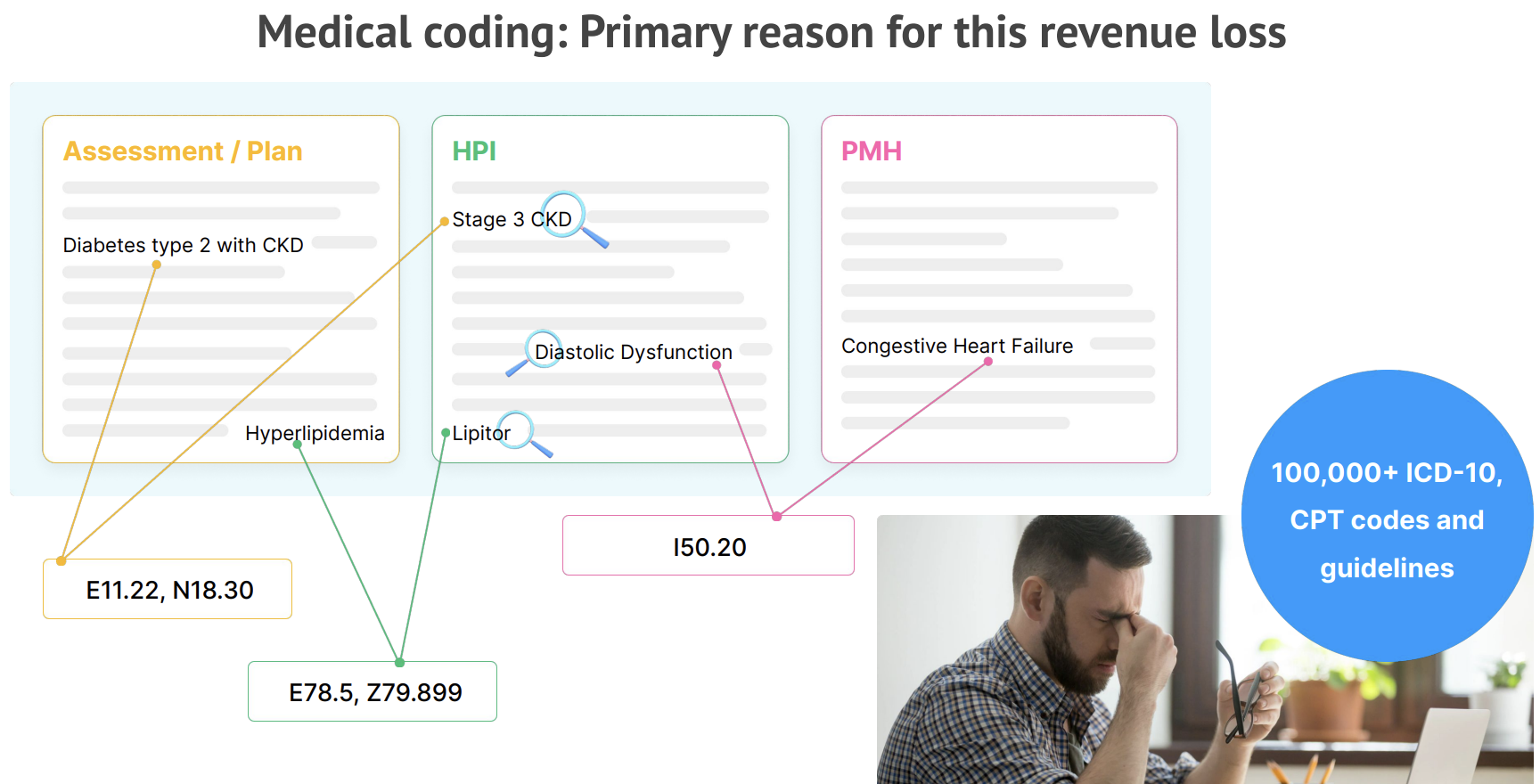
- A large, quantified, structurally underserved problem. Every dollar a US hospital earns has to pass through a code before an insurer or Medicare will pay it, drawing on more than 70,000 possible codes and often 150 or more decisions per chart. The US is roughly 30% short of the coders it needs, and the resulting errors cost the industry over US$100bn a year in denied claims, delayed payments and undercoded care.
- Real results health systems can point to. Mercyhealth lifted compliant revenue capture by 5.1% while cutting aging days by more than half. MedFirst reported a revenue uplift of over 6%. Across its base, Arintra now processes over US$5bn in annual claim value for health systems representing more than US$50bn in combined net patient revenue, at 96% coding accuracy.
- Coding is the wedge, revenue assurance is the platform. Because every dollar of hospital revenue runs through a code, the intelligence Arintra builds one chart at a time now feeds clinical documentation improvement, denial detection and appeals, with prior authorisation and DRG validation next. Owning the coding layer puts Arintra in the best position to own everything around it, and to replace the stack of disconnected point solutions hospitals stitch together today.
- The widest coverage in the market. Arintra is the first platform to code across all four care settings (ambulatory, emergency, diagnostic and inpatient), and covers 23 specialties today, adding two or more a quarter. It's live inside the Epic Toolbox and athenahealth Marketplace, and is HITRUST e1 and SOC 2 Type II certified.
The Problem
Every dollar a US hospital earns has to pass through a code before an insurer or Medicare will pay it. A patient is treated, and a medical coder translates that encounter into the alphanumeric codes that determine reimbursement, drawing on more than 70,000 possible codes and often 150 or more clinical and reimbursement decisions per chart. The US is roughly 30% short of the coders it needs to do this work, and the errors that result cost the industry over US$100bn a year in denied claims, delayed payments and undercoded care. That gap between the care a health system delivers and the revenue it actually collects is what Arintra was built to close.
How It Works
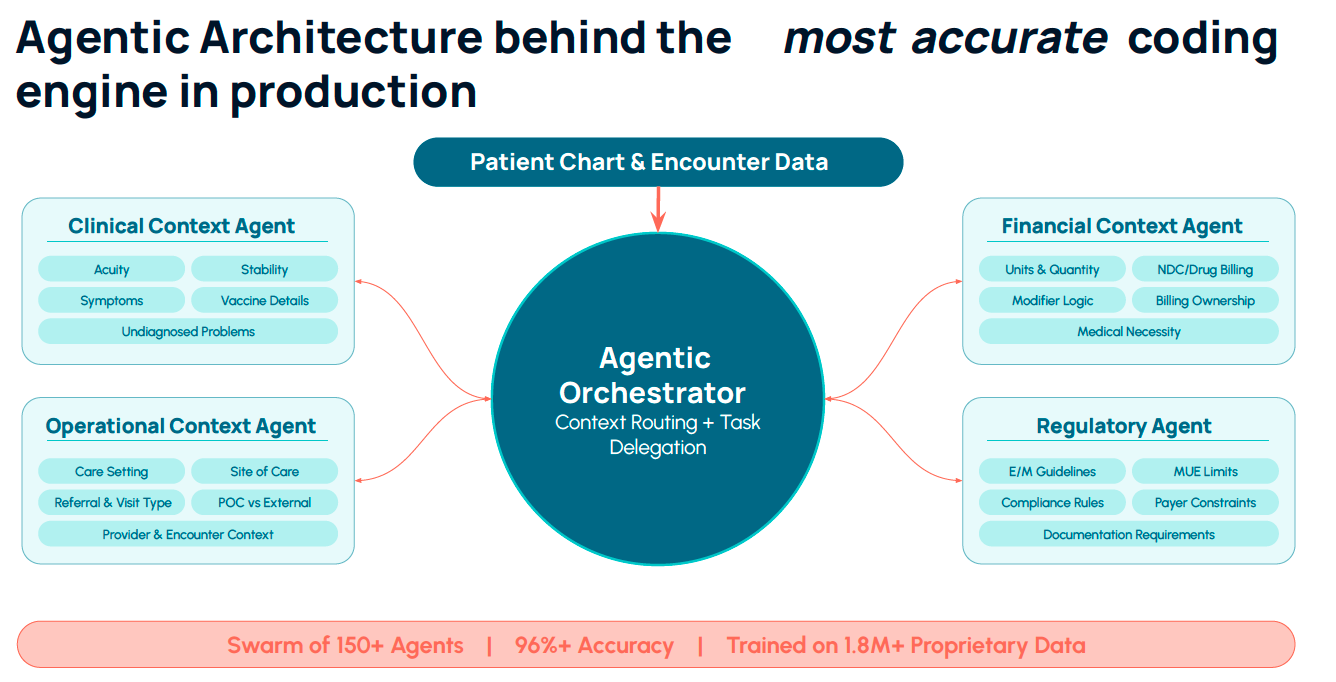
Arintra runs inside the electronic health record, and nothing changes for the provider. A doctor documents a patient encounter exactly as they do today: no new screen, no template, no coding prompt interrupting their workflow. In the background, Arintra pulls that chart from the EHR, runs it through its coding engine, and writes the resulting codes back into the record before the claim goes out through the hospital's existing billing process.
86% of charts are coded end-to-end with no human involved. The remaining 14% route to a work queue inside the EHR, the same place a hospital's coders already work, flagged with a plain explanation of why: either the documentation wasn't clear enough for the system to be confident, or the health system chose to keep a human in the loop for that scenario. Every code Arintra generates carries an audit trail back to the specific line of documentation that produced it, reviewable inside the EHR rather than taken on faith. When a claim is denied, that same trail becomes the evidence base for the appeal.
Arintra runs this across four care settings (ambulatory, emergency, diagnostic and inpatient) and 23 specialties today, from cardiology and orthopedics to oncology and radiology, adding two or more a quarter. It's the first platform on the market to cover all four settings, and no competitor covers as many specialties.
From Coding to Revenue Assurance
Coding is where Arintra started, but it's not where the platform stops. Because every dollar of hospital revenue runs through a code, the intelligence Arintra builds coding one chart at a time now feeds directly into clinical documentation improvement, denial detection and appeals, with prior authorisation and DRG validation next. A health system that trusts Arintra to code a chart accurately is also the one asking it to catch the documentation gap before a denial happens, and to write the appeal when one does.
That's a different pitch to a hospital than the point solutions that have historically stitched together US revenue cycle management. Arintra's bet is that a single agentic system, grounded in coding and extended outward, beats a stack of vendors that don't talk to each other, and that the company that owns the coding layer is best placed to own what sits around it.
Results Customers Can Point To
Mercyhealth, serving Wisconsin and northern Illinois, has used Arintra to lift compliant revenue capture by 5.1% while cutting aging days by more than half. MedFirst reported a revenue uplift of over 6% alongside stronger compliance and less administrative burden on providers. Vanova Health has eliminated provider coding and charge entry altogether.
"We chose Arintra because it integrates deeply with Epic and changed how we code without disrupting providers," said Muhammad Siddiqui, CIO at Reid Health. "We went from billing delays and high denials to faster A/R, better charge capture, and 100% chart review. It's one of the few AI tools that delivers hard ROI, fast."
"In healthcare, it is critical to have a vendor partner that you can trust, and who will work with you to address your requirements," said Kimberly Scaccia, VP of Revenue Cycle at Mercyhealth.
Across its customer base, Arintra now processes over US$5bn in annual claim value for health systems representing more than US$50bn in combined net patient revenue, at 96% coding accuracy. It's available inside the Epic Toolbox and the athenahealth Marketplace, is HITRUST e1 and SOC 2 Type II certified, and scored 93 out of 100 with an A+ rating in a 2026 KLAS Research report on emerging vendors.
The Team We're Backing
Nitesh and Preet didn't come to this problem as outsiders. Both were billed out of pocket for care their insurance should have covered, because the claim behind it had simply been coded wrong. That's a specific kind of motivation, and it shows in how precisely the product handles the edge cases that produce denied claims in the first place. Three years on, they've built a team around that founding insight that includes a VP of Revenue Cycle out of Reventics, a Director of Client Success who ran operations at athenahealth, and a Director of EHR Innovation who came from Epic itself.
The US$25m Series B funds the next stage: broadening the revenue assurance platform, expanding across more enterprise health systems, and deepening clinical and specialty coverage.